Field guide · pool service

How to sell pool service door to door

Pick territory by what you can see from orbit, knock the two weeks a year that convert, price only after you have looked at the pool, and win the season on go-backs. The whole playbook, in order.

Flat month-to-month from $30/mo · 14-day free trial · no seat minimums, no annual contract

The short version: qualify from satellite before you walk, knock outward from streets you already service, hit spring green-up and the first hot stretch, offer a free water test instead of a pitch, never quote a pool you have not looked at, and treat every "I do it myself" as a July callback. Density beats volume. Retention beats signatures.

Start with the advantage nobody else in door-to-door has

A solar rep cannot see a utility bill from the sidewalk. A pest rep cannot see ants. A roofer has to get on a ladder. You can open any mapping app, look down at a subdivision, and know within ninety seconds exactly which forty of two hundred houses are worth knocking. Use it. The single most common mistake in pool canvassing is walking a street door to door like a pest rep, burning four hours on homes that will never be customers.

The workflow that actually works: scan the neighborhood from above, pin the houses with water, then verify on foot as you walk — equipment pads visible from the driveway, screen enclosures, pool fencing, deck furniture, a diving board over the fence line. Above-ground pools are a different sale and often a different price tier, so tag them separately rather than lumping them in. Qualify the street once, and never let a teammate re-walk it.

Choosing territory: what makes a good pool street

Not all pool density is equal. These are the filters that separate a productive subdivision from a wasted week.

🛰️

Pool density first

Look for blocks where half the backyards have water. A high-density subdivision means a tight route, short drive times between stops, and neighbor-to-neighbor referrals you get for free.

🏡

Home age, not home value

Homes roughly eight to twenty-five years old are the sweet spot: the pool is past builder warranty, the original equipment is aging into replacement, and the owners have discovered how much work it is. Brand-new builds often come with builder-arranged service for the first season — skip them.

🌳

Read the trees

Heavy tree cover means more labor per stop and a higher price. That is fine — as long as you price it. A street of oaks over screened cages is not a street to quote from a printed rate card.

🚚

Distance from your existing stops

The most valuable street in your territory is the one four doors from a stop you already make. Draw the territory around your current route and expand outward, one street at a time.

🔑

Turnover

Neighborhoods with steady resale activity feed you the best door there is: a new owner who inherited a pool they have never run, whose seller's service ended at closing.

🚫

Know the local rules

Check HOA and municipal soliciting rules before you knock, and respect no-soliciting signs — tag them on the map so nobody on your crew knocks them twice. One complaint can close a whole community to your company.

Timing: the season calendar that decides your year

Pool service is the most weather-driven door-to-door product there is, and the reps who plan around that out-earn the ones who grind evenly all year.

In a year-round Sun Belt market — Phoenix, Las Vegas, Southern California, Texas, Florida — you have twelve knockable months and two real peaks. The first is spring green-up, roughly March through May, when a winter of neglect surfaces at exactly the moment everyone wants the pool ready for the season; this is the biggest switching window of the year and the one worth staffing up for. The second is the first sustained hot stretch of summer, when marginal water finally loses the fight and DIY owners run out of patience. Autumn is quieter but real: leaf drop annoys people, and cooler weather makes knocking pleasant again.

In a seasonal northern market the whole year compresses into two windows. Opening season in April and May, when you can sell the opening itself as the entry offer and roll it into weekly service. Closing season in September and October, when you sell the closing and lock in next spring's opening at the same time — a genuinely underused move, because the customer is already thinking about the pool and there is no competition knocking in October.

In both markets, the highest-converting week of the year is the same: the one after a heavy rain followed by heat. Pools on the same street go cloudy or green simultaneously, DIY owners who were fine last month are suddenly not, and you are the person standing there. Watch the forecast the way a roofer watches hail maps, and be on those streets the day after.

Time of day

Late afternoon through early evening on weekdays, roughly four to eight, and Saturday from mid-morning through mid-afternoon. Two reasons this matters more in pool than in most trades: pool service is a joint household decision more often than not, so you want both adults home rather than collecting "I'll have to ask" callbacks; and in summer, nobody wants to stand at an open front door at two in the afternoon with the air conditioning running. Sunday mornings are a fast way to get complained about. If your market is heavy on retirees or remote workers, weekday mornings are worth testing — but test it with your own data rather than assuming. More on this in the best time to knock doors.

The doorstep sequence

Five moves, in order. The scripts page has the exact words — this is the shape.

1

Name what you see

Open with the pool, not your company. "I'm doing the pools on this street — yours is the one with the paver deck, right?" Specific and true beats polished every time.

2

Sort them in one question

"Are you taking care of it yourself, or do you have somebody?" That single question puts every homeowner into DIY, has-a-guy, price-shopper or brand-new — and you run that branch.

3

Offer the water test

Not a pitch — a free two-minute test. It is useful, it is low threat, and it gets you into the backyard where the equipment pad is.

4

Look before you price

Size, tree cover, salt or chlorine, screened or open, spa and water features, equipment condition. Then quote. Never the other way round.

5

Close small

"I'm on this street Tuesdays — this Tuesday or next?" A day choice, a one-off filter clean, or two weeks of vacation coverage. Keep the yes small.

The discipline that separates good pool reps from everyone else: never quote a pool you have not looked at. A screened cage with four oaks over it and a spa is not the same job as an open pool on a bare lot, and quoting it like one loses you the account and the commission six weeks later when the company reprices it. See how clawbacks work.

The free water test is your best entry offer

Every trade has one thing it can give away that costs almost nothing and buys enormous credibility. Roofers have the free inspection. You have the water test, and it is better, because it produces a specific true fact about their pool in under two minutes.

Carry a decent kit — a drop-based test kit tells you far more than strips, and reading one in front of a homeowner makes you look like a technician instead of a salesperson. Then tell them the truth even when it does not help you close. If the water is dialed in, say so and leave. If the stabilizer is high enough that their chlorine is barely working, explain that in plain language: "this is why it goes cloudy every time it gets hot, and it's why you're buying more chlorine than you should be." A homeowner who hears one specific, unflattering, verifiable fact about their own water remembers you for the rest of the season — and that sentence becomes your go-back opener in six weeks.

Closing a recurring account, and what to say after they say yes

Understand what you are actually asking for. Not a purchase — permission for a stranger to come through their gate every week, all season, indefinitely. That is why hard closes work badly here and small ones work well: a choice of start day, a one-time filter clean instead of a plan, or covering two weeks while they travel in August. A paid one-off beats a free trial, because it gets you the gate code and a real service visit to be judged on.

Then do the part almost nobody does. The single biggest cause of early cancellation in this trade is silence. A customer who does not know when their tech comes, does not know his name, and cannot tell whether he showed up will churn inside ninety days — and take your commission with them. Before you leave the door, tell them the day of their first service and who is coming. Confirm the gate access and any dog. Tell them what the first visit will include and, if the pool needs a recovery, be explicit that recovery is a separate one-time cost from the weekly rate. Reps who bundle a green-pool recovery into the monthly price to make the sale feel cheap are manufacturing their own clawback.

Follow-up: where the season is actually won

Most pool canvassers treat a no as an ending. In this trade it is a date. Heat is a reliable, calendar-adjacent trigger that turns a spring "no thanks" into a summer "yes," and no other product gets a trigger that dependable.

  • Every DIY owner is a July callback. Tag the door, note what their water read, and set the callback for the first hot stretch. "I'm the one who told you your stabilizer was high — how's it holding up now that it's a hundred out?"
  • Every happy-with-my-guy door is a six-week go-back. Pool service churn is high and communication is why. Ask for the backup slot, leave the card, come back.
  • Weather events reset the whole list. After a heavy rain, a pollen drop or the first heat wave, go back to the marginal doors immediately — they all broke on the same day.
  • Vacations convert DIY owners. Ask when they travel in the summer, note the date, and knock the week before.
  • Ask your new customers for the neighbors. A signed account is a density opportunity: "who else on this block has a pool?" is the cheapest lead source in the business.

None of this works from memory. Forty doors into a Saturday nobody recalls which house had the salt-cell question and which one travels in August. Disposition every door, note what the water read, and set the callback so it comes due — otherwise you are cold-knocking your own best leads next month.
Run the playbook

A map that qualifies once and remembers everything

This whole guide depends on the street remembering what happened on it. FieldStacker is the canvassing half of a pool company's stack — the part before an account exists. After the sale you hand off to Skimmer, Pool Brain or whatever runs your service day, and stop scheduling, chemistry logs and monthly billing stay there.

  • Satellite knock map with custom dispositions — DIY, has a guy, above-ground, green, quoted, signed
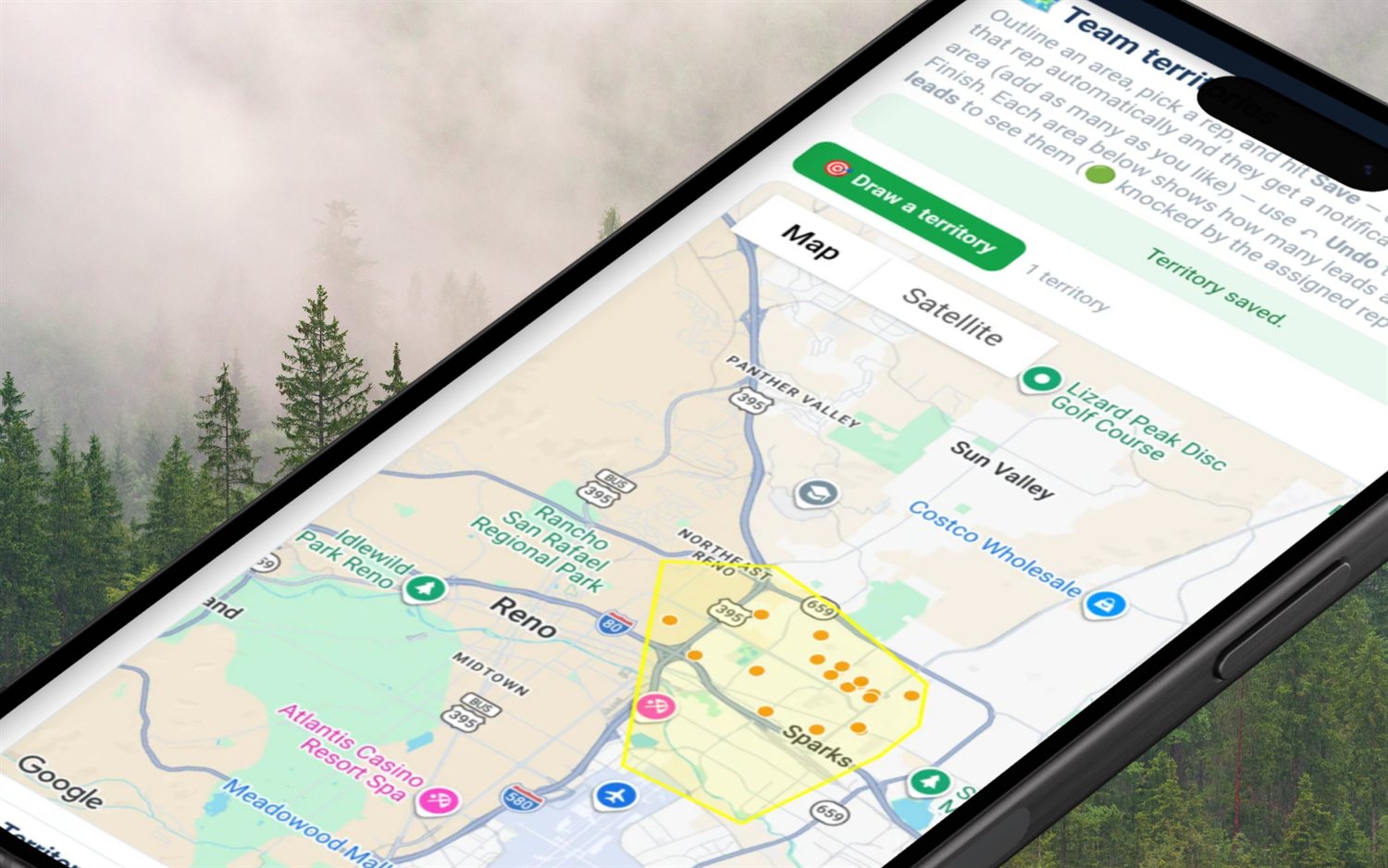
  • Territories drawn around your existing route, plus route building for the day's walk
  • New-homeowner just-sold leads dropped straight onto the map
  • Import an old customer or lead list from CSV or another CRM — addresses geocoded automatically
  • GPS-verified team knocks so nobody re-walks a qualified street
  • Callbacks that come due in July, objection coaching, and it works offline in the side yards
  • Commission, clawbacks, IRS-rate mileage and a 1099 tax set-aside

FieldStacker for pool service →   See the knock map →

FieldStacker territory tool drawing a canvassing area around an existing pool service route and assigning the leads inside it

Mistakes that cost pool canvassers a season

Every one of these is common, and every one is avoidable.

🚶

Knocking unqualified doors

Walking every house on a street instead of only the ones with water. You have satellite. Use it.

💸

Quoting from the driveway

Underpricing a screened, tree-heavy or oversized pool. The reprice kills the account and the commission.

🟢

Bundling the recovery

Folding a green-pool cleanup into the monthly rate to make it feel cheap. It blows up in week two, every time.

🗑️

Treating DIY as a no

Walking away from the most common answer at the door instead of tagging it for July. That list is most of your season.

🌍

Selling scattered

Signing accounts across a metro because they were easy. A scattered book is an unprofitable route and your company knows it.

🤐

Silence after the sale

Not telling the customer the day, the tech's name or what the first visit includes. Silence is the number one cause of early churn.

Keep reading

The rest of the pool service door-to-door library.

🗣️

Scripts

The exact words for every branch. Pool D2D scripts →

📐

Commission

Structures, clawbacks and pay timing. Pool service commission →

💰

Earnings

Honest ranges and the five drivers. What pool reps make →

🏊

The CRM

What FieldStacker covers for a pool team, and what stays in your service software. Pool service sales CRM →

🔑

Just-sold leads

The warmest pool door there is. New homeowner leads →

🏭

Other trades

Same map, different product. All industries → · Pricing →

Questions from the driveway

How do you sell pool service door to door?

Qualify before you walk. Pool service is the one door-to-door product you can see from satellite, so scan the subdivision first, pin the houses with water, and only knock those — a canvasser who walks every door on a pool street is wasting most of their day. Then knock outward from streets your company already services, because route density is what makes an account profitable. At the door, lead with what you can see, ask whether they do it themselves or have somebody, offer a free water test, and price only after you have looked at the pool. Every "I do it myself" becomes a callback for the first hot stretch.

What is the best time of year to sell pool service?

It depends entirely on your market. In year-round Sun Belt metros there are two peaks inside a twelve-month season: spring green-up, roughly March through May, when winter neglect surfaces and everyone wants the pool ready; and the first sustained hot stretch, when marginal water finally goes cloudy and DIY owners run out of patience. In seasonal northern markets the whole game is compressed into opening season in April and May and closing season in September and October. In both, the highest-converting week of the year is the one right after a heavy rain followed by heat — pools go green on the same street at the same time.

What time of day should you knock for pool service?

Late afternoon into early evening on weekdays, roughly four to eight, and Saturday mid-morning to mid-afternoon. Pool decisions are usually made jointly, so you want both adults home — a lone spouse who "has to ask" is a callback rather than a sale. Avoid Sunday mornings and avoid knocking in the heat of the day in summer, when nobody wants to stand at an open door. Weekday mornings are worth it only for retirees and for markets with a lot of remote workers.

How do you find which houses have pools?

Satellite view, then verification on foot. Scan the neighborhood from above and pin every house with water, then confirm on the street from equipment pads, screen enclosures, pool fencing and deck furniture. There is no button that detects pools for you — in FieldStacker or anywhere else — but a satellite knock map with your own custom dispositions means you qualify a street once and never re-walk it. Layer the recently-sold addresses on top and you know which of those pools just changed owners, which is the warmest door in the trade.

What is the fastest way to build a pool route from scratch?

Pick one small area and saturate it rather than chasing scattered leads across a metro. Choose a subdivision with high pool density and homes old enough to be out of builder warranty, work it street by street, and take every account you can get inside it — including one-off filter cleans, which put you in the backyard with a gate code and convert to weekly later. Density is worth more than volume: six pools on one block is a ninety-minute stop, six pools across town is an unprofitable day. Then work your callbacks in July when the DIY owners break.

Do I need a license to sell or perform pool service?

It varies a great deal by state and by what you actually do. Routine cleaning and chemical maintenance are unregulated in some states and licensed in others, and repair or equipment work above a dollar threshold very often requires a contractor license — California's C-53 swimming pool classification and Florida's pool and spa servicing license are the two most frequently cited examples. Some states also regulate the application of certain chemicals. If you are canvassing for an established company this is their exposure, not yours, but you should still know what you are legally allowed to promise at a door. Check your own state before assuming.

Qualify a subdivision before you walk it

Pin the pools, draw the territory around your route, and set the July callbacks as you go. 14-day free trial, no credit card, flat month-to-month.